

The Early Development Instrument: Overview

Measuring trends and patterns in children’s physical, emotional, social and cognitive development at kindergarten for over two decades.
The foundational goal of the EDI is to promote “equity from the start.” Over time, EDI data have highlighted that there is great disparity in the rates of children’s developmental vulnerability across different geographic areas in BC – children’s development is impacted by where they live in the province. For over 20 years, HELP has been dedicated to exploring this story.
Child development is influenced by many individual and contextual elements: from inherited biological and family factors to larger social, economic, and policy contexts. The characteristics of the environments in which children live and grow influence their development and readiness to learn as they enter school for the first time. Decades of HELP’s research reinforces the value of investing more robustly in early childhood development – it is society’s collective responsibility to provide the best possible start for all children.
A World Class Dataset
EDI data have been collected for over 330,000 children in BC and over 1.3 million children across Canada
20 Years of Data
HELP has been collecting EDI data in BC for over 20 years
Whole Child
A “whole child” questionnaire that includes 103 items covering five core areas of development
Teacher Completed
Completed by kindergarten teachers for children in their classrooms in February of the school year
Trends and Patterns
Is used to measure trends and patterns in children's development at the population-level, not for individual screening or diagnosis
The EDI is Voluntary
Parents, teachers and school administrators can choose not to participate at any time through the data cycle

What is the EDI?
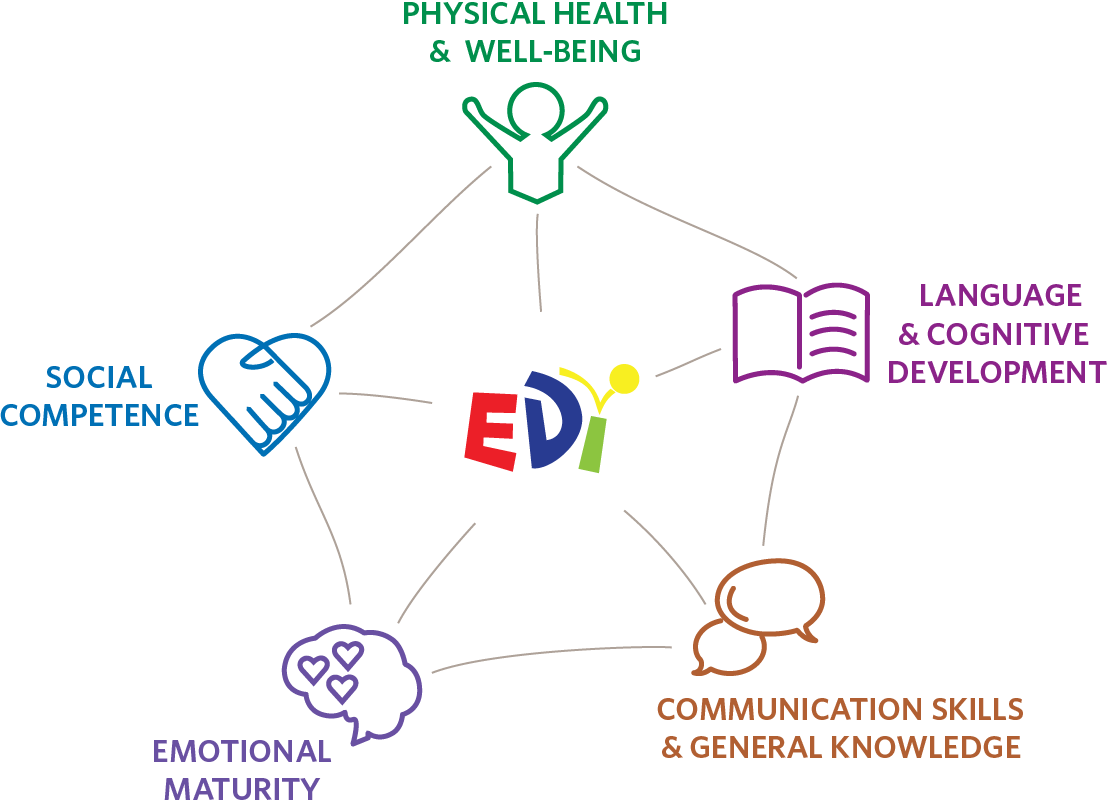
The Early Development Instrument (EDI) is a questionnaire completed by kindergarten teachers for the students in their classrooms during each February of the school year. It was developed by Dr. Dan Offord and Dr. Magdalena Janus at the Offord Centre for Child Studies at McMaster University in Hamilton, Ontario, with the help of experts on child development, kindergarten teachers and school administrators. Originally created as a “whole child” measure of school readiness beyond just academic skills, the EDI gathers information about five core areas of early childhood development: Physical Health & Well-being, Social Competence, Emotional Maturity, Language & Cognitive Development, Communication Skills & General Knowledge.
Since 1999, HELP’s founder (Dr. Clyde Hertzman) and the organization’s faculty and staff have collaborated with the Offord Centre to expand EDI data collection across BC. This data has been instrumental in drawing attention to the connection between children’s development and the social determinants of health and highlighting why the early years matter as a time for focused investment and support.
EDI Scales & Subscales
The EDI questionnaire gathers data about five core areas of early child development. Each EDI scale is made up of a set of subscales that measures a specific area of development within the scale. The chart below shows the relationship between EDI scales and subscales.
| Scales of the EDI | Description | Subscales | |
|---|---|---|---|

|
Physical Health & Well-being |
Children’s gross and fine motor skills, physical independence and readiness for the school day. |
|

|
Social Competence |
Children’s overall social competencies, capacity for respect and responsibility, approaches to learning, and readiness to explore new things. |
|

|
Emotional Maturity |
Children’s prosocial and helping behaviours, as well as hyperactivity and inattention, aggressive, anxious and fearful behaviours. |
|

|
Language & Cognitive Development |
Children’s basic and advanced literacy skills, numeracy skills, interest in math and reading, and memory. |
|

|
Communication Skills & General Knowledge |
Children’s English language skills and general knowledge. |
|

EDI Vulnerability
Data collected using the EDI measures the rate of the developmental vulnerability of kindergarten children at the population level. Children are considered vulnerable on the EDI if, without additional support and care, they are more likely to experience future challenges in their school years and beyond. Each scale of the EDI has a provincially-determined cut-off score. If a child scores below this cut-off, they are considered “vulnerable” in that area of development. Children’s EDI scores on these scales reflect the many inherited and contextual factors that influence children’s development. Aggregated EDI data provide a valid and reliable measure of vulnerability in child development over time and across various geographic areas.
Reporting EDI Vulnerability
For each of the five scales of the EDI, the proportion of children vulnerable are reported as vulnerability rates.
Vulnerable on One or More Scales is a summary measure that reports the percentage of children who are vulnerable on at least one or more of the five scales of the EDI. Children included in this measure may be vulnerable on only one scale or may be experiencing vulnerabilities on multiple scales of the EDI.
EDI Data Collection
HELP has been collecting province-wide EDI data in BC since 2001 – all public school districts as well as some independent and First Nations schools have participated in the data collection over time. This data is collected in partnership with the education system on a three-year schedule called a “Wave”. HELP is currently in Wave 9 of EDI data collection.
Learn more about EDI data collection in BC, including information regarding privacy and security by visiting the EDI Data Collection Page.
EDI Reports and Maps: Reporting Trends in EDI Vulnerability
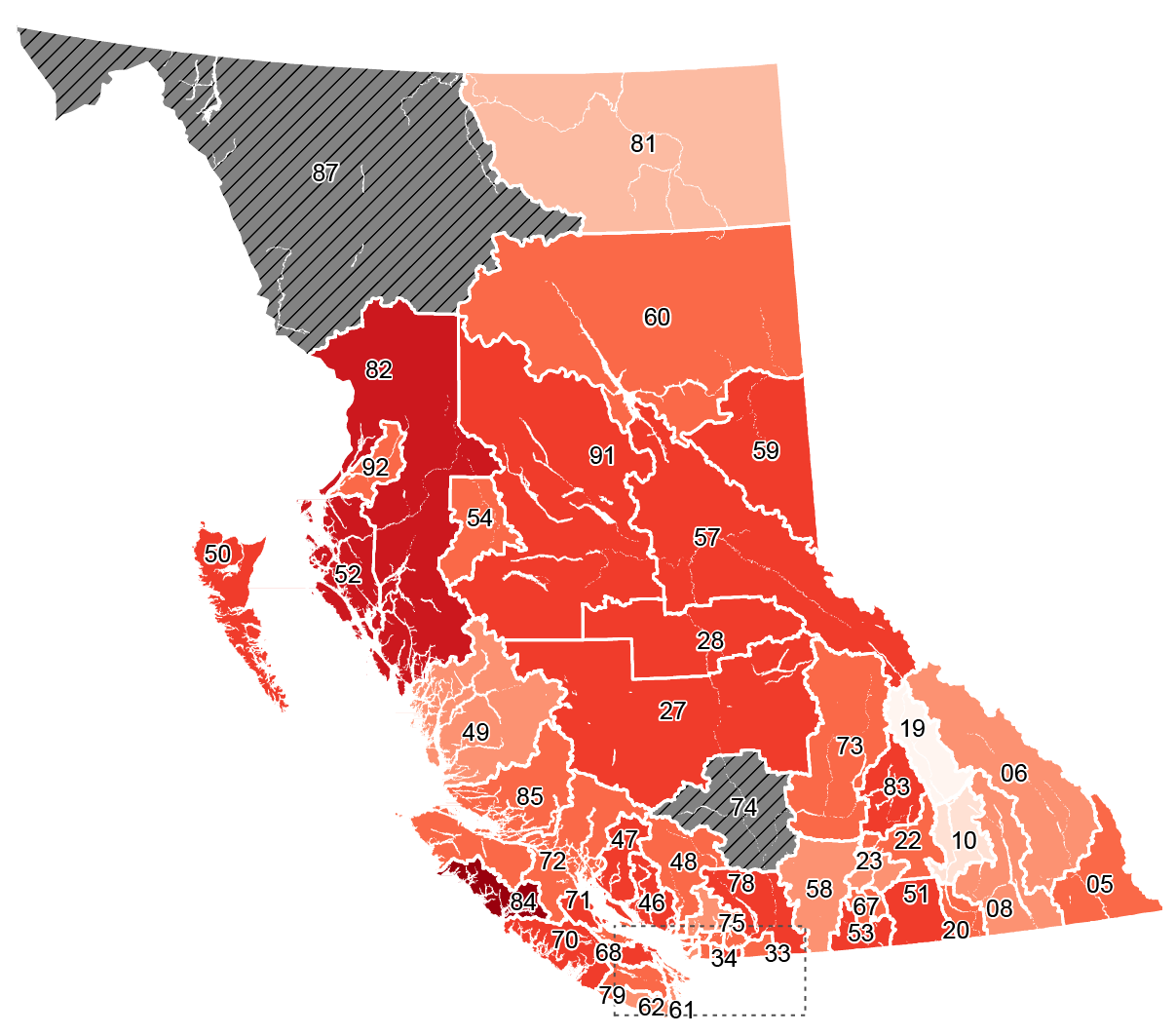
Collecting EDI data over multiple waves allows us to explore important issues in children’s development including meaningful changes in vulnerability rates over time, differences in vulnerability rates across geographic locations, and more. HELP creates maps and reports that summarize trends in EDI vulnerability rates along with other EDI data at provincial, regional, and neighbourhood levels, as well as School District and Health Service Delivery Areas. EDI maps and reports are a resource for communities, schools, and governments to better understand childhood vulnerability in jurisdictions across the province and over time.
Private Reports
EDI data collected during the school year of participation is summarized in the EDI Annual School District and School Reports and provided directly to districts and schools. These reports are not shared publicly to avoid ranking and comparisons of schools.
Public Reports
Provincial, community, and neighbourhood-level reports are made available to the public at the end of each 3-year wave of EDI data collection and can be found on the Reports page.
HELP also hosts an EDI Data Dashboard to explore the province’s EDI data within education, health and community level boundaries.
EDI Research
The EDI has undergone rigorous validation and reliability testing over the years, with both Canadian and international samples. There has also been a wealth of published research using EDI data on a variety of topics over the past two decades, as outlined in this narrative review.
The EDI was developed at McMaster University’s Offord Centre for Child Studies. Their website hosts a searchable EDI bibliography database that can be accessed here.
EDI Data in Action
EDI data have been used effectively over the last 20 years to support collaborative conversations and planning, contribute to policy and decision-making processes, and identify opportunities for action and investments at the provincial, regional and local level. Learn more about HELP Data in Action.

Widening the Lens: EDI and the Child Development Monitoring System
The EDI was the first questionnaire implemented by HELP in British Columbia in 2001. HELP has since developed a collection of tools designed to gather data at important transition times during childhood. Along with the EDI, the Child Development Monitoring System includes the Toddler Development Instrument (TDI), the Childhood Experiences Questionnaire (CHEQ), the Middle Years Development Instrument (MDI) and the Youth Development Instrument (YDI). These questionnaires gather information on both child development and the contextual factors that influence development, specifically experiences and environments. This Monitoring System is a foundation for high-quality research and for informed policy and program decision-making.
Toddler Development Instrument
Parent & Caregiver Questionnaire
Childhood Experiences Questionnaire
Parent & Caregiver Questionnaire
Early Development Instrument
Teacher Questionnaire
Middle Years Development Instrument
Student Questionnaire
Youth Development Instrument
Student QuestionnaireKey EDI Contacts

Barry Forer
Research Methodologist

Kate Buium
Knowledge Broker, Knowledge-to-Action Team